Justinian as Conqueror Ivory Plaque ââåbarberini Ivoryã¢ââ Byzantine Art C 500550

The hidden letters in
early on Byzantine art & the Barberini Ivory
Ani Margaryan
Arts & History Writer
The Barberini ivory is a Byzantine fine art ivory leaf from an imperial diptych dating from Late Antiquity, now in the Louvre in Paris. This is the only near-complete foliage of an imperial diptych to have come up down to the states and 1 of the well-nigh well-known artworks of the Byzantine Empire. It owes its name to Primal Barberini, to whom Peiresc gave it as a gift, on the back is a listing of Barbarian kings and officials of the region, and so the early researchers called it as well "Barbarianivory." The artwork was created in the Byzantine Empire in the get-go one-half of the sixth century; this menstruum is marked with the dominion of Justinian the First Great (527-565).
The upper panel
The upper horizontal panel represents the "St. Saviour in celebrity"- the medallion in the centre of the limerick with the bust of Jesus Christ, which is being held past symmetrically bundled ii winged figures considered to be angels or archangels. On his left and right sides the Dominicus, the Moon, and the Star are depicted schematically, and the medallion itself is the symbol of the Earth or the Globe, so the whole composition represents Jesus as the conquistador and the Lord of the Universe.

The upper panel
The interpretation of the beardless and young epitome of Christ- the iconographic type known as "Emmanuel" has some indirect parallels with the aspiration of the Ancient Greeks of depicting both the humans and Gods in their young and arcadian appearance. The iconographic theme "Christ in glory" or "Cross in glory" is often executed in Early Christian monuments. However, the structure of the composition and the origin of protagonists are inspired from the Roman marble sarcophagi reliefs of the beginning to fourth centuries where the deceased soldiers' or generals' bust (imago clipeata) in the medallion is being rising to the heavens past the nude winged figures of Telus and Oceanus.

The left panel
On the left vertical panel there is a male person figure in the military machine attire, continuing with one human foot in front of some other, peradventure captured in the pose of walking, nether the arch decorated with two Corinthian orders. On his paw he is holding a female figurine of the winged Victory- Roman goddess of triumph who herself standing in one foot, the other is raised up, she holds a laurel wreath intended for the figure on the central panel to whom the male figure is moving. The interior with the Corinthian orders, type of sandals, the military uniform, the Victory in nearly transparent gown which does non hide her torso forms, and the wreath- borrowed from the Roman fine art. The identity of the male person figure still is a question of debate, in fact, there are at to the lowest degree three theories on this issue: a Byzantine ground forces soldier, a full general of the same army, or a consul.
The left panel
The central panel
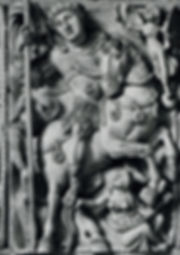
The kickoff researchers of this artwork suggested a number of theories on who is carved equally the warrior and horseman in the central panel. Some of the early suggestions on the delineation of the delegate, not the Emperor himself, come from the compositional and stylistic similarities with the "consular diptychs", just the farther studies on the representation of the main effigy, the headdress or headgear in the grade of the crown, the common features with the depiction of Justinian on the famous mosaic of San Vitale chapel, the head of the panthera leo on his sandal made the scholars believe that it is the Emperor Justinian who is depicted. Moreover, the equestrian statue of Justinian which did not survive to us, the representation of Justinian as the horseman accompanied by Victory in the multiple solidus c. 534, as in example of the discussed ivory, the quantity of the Christian symbols combined with Roman motifs in the coins of Justinian, the stylistic features of the ivory with motifs close to Greco-Roman tradition, and some of them borrowed fifty-fifty without any change of symbolism and usage- left almost no dubiousness to classify this artwork within the frameworks of the Justinian age and as the rare artwork presenting him as the triumphant emperor.
The muscles of the right arm holding the spear and the lower part of the bear leg aimed to show him every bit a physically stiff warrior every bit war itself was not represented. The horse with two forepart legs raised, in the pose of "roaring" traditional in Greco- Roman art, has both stylistic and iconographical parallels with classical artifact. The latter's influence is noticeable on the disproportion of the Emperor's figure, traces of deformation in the course and shape of his head which is obviously bigger in comparing with the other parts of the trunk, accentuating the facial expression of Justinian, which is at-home, self-confident, full of grace and contemplation, contrasting with the Barbarian face adjacent to his spear. And this calmness therefore quite different from the Roman samples, Justinian is not shown during the battle or beingness engaged in the state of war though we see his enemy behind the huge spear. He already won the state of war and ane can admire the results, not the process as Aboriginal Romans tendered to do.
The eloquent battle scenes are replaced with the tranquil and confident character of the Emperor who does non see the need to stand for his efforts on the mode of his victory. And the result for the non-depicted victory is the image of the Barbarian next to the enormous spear, and we know he's a Barbarian at least past his so-chosen "Phrygian cap"- the attribute which was largely used in Christian art to identify "not-Christians" or "enemies" of Christians. Even the depiction of the "enemies" in "Phrygian caps" is peculiar for Greco-Roman arts (see Ludovisi Battle Sarcophagus).
The central panel
Another Roman feature of the central console is the use of allegorical figures: the female figure nearby the huge hoof of a royal horse, is looking straightly to the Emperor with adoration, holding his foot with i hand and her drapery with fruits with another, one of her chest is barely airtight. This is an allegorical representation of the Globe or the conquered country or the goddess of Earth-Gaia and with her gesture, she's demonstrating her support to Justinian and the fruits in her easily are the symbol of the prosperous kingdom. Her presence in this composition is another strong accent of the occurred triumph.
The lesser panel
According to the visual qualities and formal characteristics of this horizontal register, we can claim that the field of study matter appears to be a "procession"- two human figures similar in clothing and appearance in the left corner and some other couple in the correct corner also with similar facial features and wearing apparel are linked in the eye past the winged figure- an angel or rather a Victory. The group on the left with their hats, bearded faces, round-shaped big noses, long tunics combined with trousers or pants, are identified as the "barbarian" tribes from the West of the Roman Empire which was during the 6th-century invasions from time to fourth dimension the borders of Byzantine Empire. 1 of them holding a circle-symbol of the divine kingship and power, the second one- golden coins in the basket.

The lesser panel
In that location is likewise a lion in a bowed position in their row. The current details all together symbolize the post-obit idea: the Barbarians from the Westward pay tribute to the figure in the central panel-Justinian, by presenting him the all-time they have- the symbol of divine kingship, their wealth- the gold, and the lion, maybe one of their symbols or just the allegory of their fallen kingdom bowing to the Byzantine Emperor.
The similar ideas dominate on the correct corner too, but with a noted difference: hither our gazes are upon the people, "non-Byzantines" from the E- deport-chested, with the Oriental turban, wide, knotted pants and sandals. So these people also accept Justinian every bit their emperor- giving him all their lands can provide them. The trunk of the elephant is almost touching the so-called "trophy" in the hand of Victory, and the use of the current detail especially in the very centre of the register stresses the idea of the conquest of the West and the Eastward by the Byzantine Empire. The postures and gestures of the figures accept their origins from the Roman arts, particularly the fourth-century obelisk reliefs of the Roman Empire Theodosius the Get-go, only the idea of the procession with the highlighted ideology of the conquest and acceptance of the treasures from the conquered lands presented by the natives is yet depicted in the processional scene of the Persepolis, Apadana hall of the Persian kings (c. 520-465 B.C.Due east.) and seem to have a similar office- to reinforce the breadth of the dominance of the emperor.

The Barberini Ivory
A tiny compositional trait- the cornerstone of the content and function
As the possible and obvious parallels with the Greco- Roman art and even certain artefacts are completely done revealing every single influence from Roman ivories and reliefs, a question comes to mind: the variety of motifs, figures, gestures, poses, facial features, and finally the structure of the scene directly and indirectly borrowed from Romans, actually Ancient heathen Romans, so what could be called "Christian" in this ivory? Justinian who was the possible patron of the current ivory wished not simply to proceed the history of the Groovy Roman Empire but also to propagandize his devotion to Christianity. And so which role or item of this artwork expresses the electric current idea and whether does express or non?
Let us have one more than glance at the item which seems to be non that significant: the depiction of the barbarian next to the spear of Justinian. The point is the enormous spear does not go through his body, his leg, and fifty-fifty his shoe. It seems the barbaric- and we already know he is a barbarian by his Phrygian cap and appearance common to the Western barbarians below- just hides behind the spear, belongings it past i manus, and raising another pointing Justinian. The gesture of his paw refers to the "astonishment", either meant to point again the figure of the Emperor or revives the gesture of the apostles of "following the words of Christ". Thus the composition claims that Justinian could and had that ability but did non desire to kill his enemy on purpose, and the Barbarian himself expresses willingness to follow him.

If nosotros turn to the Bible, nosotros'd easily find the verses expressing the ideas of good treatment to foes-enemies, avoiding the violence on them, and that every act of establishing the peace with the enemies could be blessed by God. "Do not repay evil with evil or insult with insult. On the opposite, repay evil with approving, because to this you were chosen so that you may inherit a blessing." (Peter 3:9). Luke writes. "Therefore be merciful just equally your Begetter also is merciful" (Luke six:36), and finally Matthew tells the story of Christ'due south teaching, "You accept heard that it was said, 'You shall love your neighbor and hate your enemy.' Simply I say to you, Dear your enemies and pray for those who persecute you lot, so that yous may be sons of your Father who is in heaven" (Matthew five:43-45). And probably one of the reasons why in the bottom panel of procession barbarians- "evils" are not depicted kneeled or in the pose of begging or hardly suffering in torture in the defeated posture, are the following verses: "Do not gloat when your enemy falls; when they stumble, do not let your heart rejoice", (Proverbs 24:17) and "Blessed are the pure in centre, for they shall encounter God. Blest are the peacemakers, for they shall exist called sons of God." (Matthew 5:viii). The Swedish theologian Ulrich Luz states that the ideas expressed in the current verses "considered the Christian distinction and innovation", "Love thy enemies" is what separates Christianity from all before religions.
So the unknown artist or artists who created this masterpiece and were, equally we supposed, from the Christian workshops opened by the court of Justinian, were aware of the new religion and used this motif to stress the image of the Emperor not only equally the proficient warrior, triumphant in the "Roman" significant of this word, just also "victorious" in "Christian" meaning-"peacemaker" who is blessed, who did not detest and decimate his enemies and is "good to them". This stressed peaceful grapheme of Justinian stands out when we compare to the Roman art samples (Ludovisi Battle Sarcophagus) where the foe is physically and emotionally indelible agony, and the imperial power is expressed in cruelly killing the barbarians and there is no place for mercy. Even comparing the Barberini Ivory with the much earlier artefacts such as the Victory Stele of Naram-Sin (2254-2218 B.C.E.) and Narmer Palette (3200-3000 B.C.E.), as the three artworks have the same narrative- "triumph of the ruler over his foe" and the same iconography in the meaning of "divine victory". In aboriginal samples the figures of foes in miseries occupy big parts of the composition, but in case of the Byzantine ivory the very moment of forgiveness and mercy to the enemy-barbarian is pictured avoiding the encarmine crowded scenes and human being sufferings, even the participants of the procession below seem to be joyful to be the office of Justinian's empire.
Why did the artists select this character exactly during Justinian's age and for Justinian himself? At that fourth dimension rather, the private preferences of the patron were evaluated more than the artistic goals of the creative person himself. The time this diptych was created Justinian concluded the long-lasting state of war with the Sassanid Persia with the "The Perpetual Peace"(ἀπέραντος εἰρήνη), signed in 532 between the East Roman Empire and Sassanid Persia, and this diptych was a peachy tool of propaganda for the Emperor to stand for his political decision as his ain "victory", forming the image of the omnipotent and wise ruler of Byzantine Empire which prefers peace and established order. More likely the bag with the money on the left console indicates exactly the amount of golden Justinian paid for the peace with Sassanids. Justinian'southward period was not peaceful at all: wars, rebellions, riots, invasions and the ain ambitions of the Byzantine Emperor to build the 2nd Roman Empire, so perchance for stressing the equivalent of victories in these narratives which found their reflections on the Barberini ivory, artists included totally three images of Victories in only i diptych- the one in the procession- Romanised, with "bays" the other in the hands of the full general in the left panel and the last i in the process of crowning the emperor.
Our argument on this artwork to be of propaganda purpose becomes stronger when we explore a bronze panel (Byzantine and Christian Museum of Athens) from the same historical menstruation. The latter's composition is almost the replica of the Justinian image, the curves, the position on the equus caballus, the gestures of the central figure with the Barbarian on the left. Thereby, the epitome of "peacemaker" and "peace-defender" Emperor was in need for that time so they repeated it again. Some other historical fact which strengthens our theory on the Christian nuance of this ivory is the juridical reforms by Justinian. According to his "Corpus Juris Civilis", numerous provisions served to secure the status of Christianity as the state faith of the empire, uniting Church and state, and making anyone who was non continued to the Christian church a non-citizen. The very first police force in the Codex requires all persons nether the jurisdiction of the Empire to hold the Christian organized religion. So for the implementation of these rules Justinian could use numerous artworks just similar Barberini ivory, mosaics in Ravenna and the repetition of the ivory composition on the statuary plaques as an example for the citizens of his vast empire how the words and the order of Christ should be followed past and that he is the 1 who deserves the crown of the Christian emperor who treats his foes with wisdom and kindness.

Discover, Learn & Capeesh.
GALLERIA
The hidden letters in the Barberini Ivory
Discover, Learn & Appreciate.
Source: https://www.artstoriagalleria.com/the-barberini-ivory
0 Response to "Justinian as Conqueror Ivory Plaque ââåbarberini Ivoryã¢ââ Byzantine Art C 500550"
Post a Comment